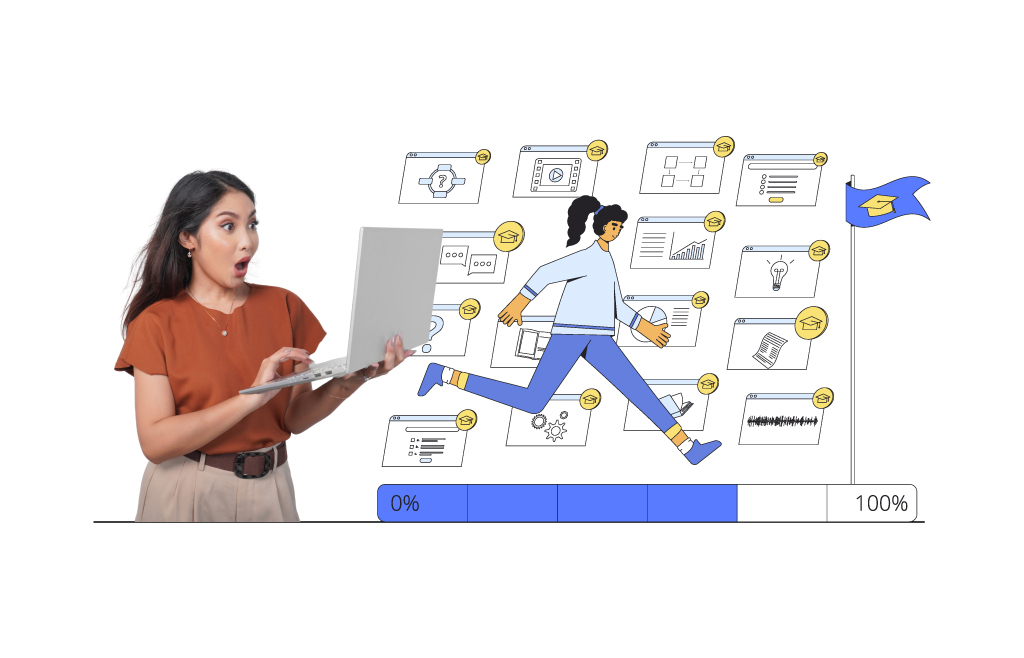
A third of L&D budget is wasted on employees who stop taking training’s due to lower than standard completion rates. Use behavioral nudges when training’s completed will increase completion rates from 25-40% to 60-85%. This guide contains seven different nudges supported by research, steps for implementing in the LMS.
Understanding Behavioral Nudges in Training
Nudge Theory is an idea developed by a Nobel Prize-winning author, Richard Thaler, which encourages individuals to complete work without creating mandates – these are considered choice architecture. They can be used in the LMS to get employees to complete their training through loss aversion, social proof, and micro-commitments, allowing them to complete 85% of the training, up from 42%.
7 Proven Nudges to Boost Completion
1. Personalized Timely Reminders
Triggering Email or Slack Notification of Inactivity – “Almost Complete (10 min)” – This leverages the idea of Loss Aversion and, on average, you can produce an 85% success rate for 2-3 of these email messages/week.
2. Progress Visuals and Micro-Goals
Visual Cues to Show Progress – For example, create streaks and badges by watching and finishing two quizzes in order to receive the badge; leverage the Zeigarnik Effect to drive toward closure. This has resulted in a 30% increase in registrations (i.e. enrollments) and has doubled the speed of completion.
3. Social Proof Messages
Peer Norms of Team Members Who Have Completed Work vs. Non-Completed Work – Team members who have completed a course are reporting an increase in scores by 15% on average for completing a course vs. choosing not; encourage the use of leaderboards to provide a competitive environment within peer groups.
4. Default Opt-Ins and Simplification
Single Next Action Buttons to Reduce Friction – By automatically enrolling individuals in courses and providing a single next action button you reduce friction and increase user’s ability to complete their goal. Once your users have identified the path to complete their goal, you can further reduce their ability to make decisions by creating a clear course path for each user.
Additional Read:
Data-Driven Training: How to Use Analytics to Improve Employee Performance
5. Commitment Devices
Public Pledge or Deadline to Attend 3 Class Sessions / Week – Those who made a commitment to attending 3 class sessions/week had a higher rate of follow-through (20%-30% more likely) as opposed to those who did not.
6. Gamified Rewards
Micro Badges and Streaks Provided Through Nudge – Using nudges (e.g. reminders) to encourage users to achieve micro badges and/or streaks resulted in a 48% increase in user engagement.
7. Escalating Nudges
Begin Gently and Increase Intensity – During day 3 you provide a nudge (e.g. a hint on how to complete a course) and day 7 provide a challenge from a peer for their completion. This technique has the potential to increase conversion rates by double the average rate.
Start gentle, intensify: Day 3 hint, Day 7 peer challenge; 2x conversions.
| Nudge Type | Baseline Completion | With Nudge | Lift |
|---|---|---|---|
| Reminders | 42% | 85% | 2x |
| Progress Bars | 25-40% | 60-80% | +35-40% |
| Social Proof | 45-60% | 75-90% | +30-45% |
| Optimal Frequency (2-3/wk) | 65% | 85% | +20% |
Step-by-Step LMS Implementation
- Audit Drop-offs: Use analytics for triggers (e.g., 7-day inactive).
- Build Templates: Action-oriented, personalized (e.g., “Your streak ends soon!”).
- Set Rules: Behavior-based (80% complete → nudge).
- A/B Test Channels: Email vs Slack; track opens/conversions.
- Optimize: 2-3 nudges/week max; monitor 85% target.
- Scale: Automate for all courses.
Conclusion
SkillTriks automates behavioral nudges for training completion with LMS reminders, gamification, and AI-personalized prompts delivering 35-40% lifts to 80%+ rates. Track via dashboards, A/B test effortlessly, and scale across teams for 2x ROI without extra effort.
